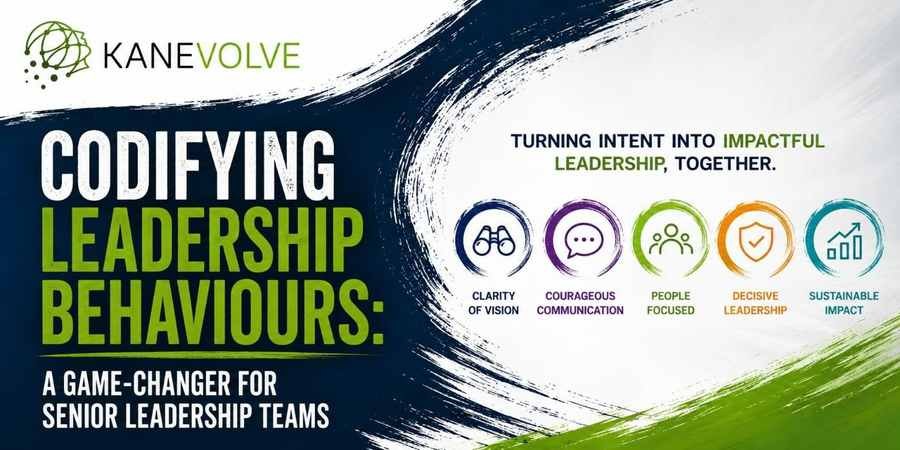
Codifying Leadership Behaviours
What good leadership looks, sounds and feels like
John Kane
Founder, Kanevolve
One of the things I have noticed repeatedly in my coaching work with senior leaders is that we spend a lot of time talking about what we want leaders to achieve, but considerably less time talking about how we want them to lead.
Most schools have a clear vision. They have values. They have improvement priorities, strategic plans and carefully considered structures. But ask a senior leadership team a slightly different question – “What should it actually feel like to be led by us?” – and the answer can be much harder to articulate.
That matters.
I often share the story of walking into a school that had the word “Respect” written on the side of the sports hall. It was written in such a way that it could have been seen from the ISS. Yet, upon entering the reception, a door was closed in front of me, and I stood for 15 minutes before a surly receptionist asked me, “Yes?”
Leadership culture isn’t really created by the words written on the website or displayed on the walls. It is created through hundreds of small interactions every week: how leaders respond when something goes wrong, how they challenge somebody, how well they listen, whether they empower or take over, how they behave under pressure and how consistent their behaviour is when things become difficult.
This is why I have become increasingly interested in helping leadership teams to codify their leadership behaviours. Put simply, it means agreeing what good leadership looks, sounds and feels like around here.
Moving beyond individual leadership styles
Every senior leadership team is made up of different personalities. That is exactly as it should be. Some leaders naturally bring energy and vision. Others are brilliant organisers. Some build relationships effortlessly, while others bring challenge, decisiveness or a reassuring sense of calm.
I see these differences all the time with my coaching clients, and I certainly wouldn’t want to remove them. Effective leadership teams don’t need everybody to become the same kind of leader.
But there is a difference between individuality and inconsistency.
If staff experience radically different expectations, behaviours or approaches depending upon which senior leader they are dealing with, leadership can begin to feel unpredictable. Over time, that inconsistency starts to shape the culture.
Codifying leadership behaviours gives a team something to anchor itself to. It allows leaders to say:
“We might have different personalities and different responsibilities, but these are the behaviours people should consistently experience from us.”
That is a powerful conversation for a leadership team to have.
Turning values into behaviours
Schools are generally very good at identifying values. Words such as respect, ambition, integrity, kindness, courage and excellence appear everywhere. The challenge is turning those words into everyday leadership. If we say we value trust, what does a leader actually do that creates trust? If we say empowerment matters, what would I see senior leaders doing differently? How would that translate into action in all meetings, and of course, in every classroom? If we value challenge, how do we make sure that challenge is constructive rather than intimidating?
And perhaps most importantly: would staff recognise those behaviours in us?
This is where codification becomes useful. It takes something abstract and makes it observable.
In my work through Kanevolve, the Balanced Leader provides one way of starting that conversation. It asks leaders to think about seven areas of their leadership: visionary thinking, communication, empathy and emotional intelligence, empowerment, authoritative presence, organisation and systems leadership, and adaptability and resilience.
The point isn’t that every leader should be equally strong in all seven areas. They won’t be. That’s why honest communication across a diverse team matters. The value comes from developing the self-awareness to recognise what I naturally bring, what I sometimes overplay and what I may need to deliberately dial up.
From “this is who I am” to “this is what people need from me”
This is often where the coaching gets interesting. I regularly hear leaders describe themselves by saying things such as:
- “I’m just not very confrontational.”
- “I’m naturally quite direct.”
- “I like to give people lots of autonomy.”
- “I’m a details person.”
- “I tend to take things on myself.”
None of these are necessarily strengths or weaknesses. What matters is whether that behaviour is what the situation and the people around them actually need. Leadership requires range.
An empowering leader sometimes needs to become more authoritative. A highly organised leader may need to resist controlling everything. An empathetic leader may need to challenge more directly. A visionary leader may need to spend more time on the systems that turn the vision into reality.
Codifying behaviours therefore gives us a much richer coaching conversation. Instead of simply asking, “Am I a good leader?”, we can ask: “What behaviour does this situation require from me?”
That is a much more useful question.
Making leadership visible to each other
There is another important benefit. Once leadership behaviours are articulated, members of the senior team can begin talking about them with each other.
Rather than leadership development remaining private – something discussed during an appraisal or perhaps in an individual coaching session – it can become part of the team’s everyday professional dialogue. Having a shared language will also lead to consistency in the way leaders, at all levels, behave.
A leader might acknowledge that they have been holding on to too much and need to empower more. Another might recognise that they have avoided a difficult conversation and need to show greater authoritative presence. Someone else may realise that pressure is affecting the way they communicate.
This requires trust, of course. It also requires deliberate and intentional reflection (something I’ve articulated in my article on journaling).
But when teams become comfortable having these conversations, something shifts. Leadership development stops being about fixing individual weaknesses and becomes collective learning.
That is one of the reasons I encourage my coaching clients to journal. Reflection creates a small gap between experience and response. Leaders begin noticing patterns: what triggers them, what they avoid, what they repeatedly take on themselves and how their behaviour affects others. Starting with “self”, a great team will then encourage each other to move from individual reflection towards greater self-awareness, team insight, peer coaching and mutual growth. For me, that is where much of the real value sits.
Codification without compliance
There is a danger here that is worth acknowledging. Codifying leadership behaviours should never become another checklist. If we reduce leadership to a set of competencies that leaders simply have to demonstrate, we risk losing the very thing we are trying to develop: thoughtful, adaptive and authentic leadership. The behaviours should create a language for reflection, not a script for leadership.
They allow teams to challenge themselves and each other:
- Are we actually behaving in the way we said we would?
- What are staff experiencing from us at the moment?
- Where are we inconsistent?
- Which behaviours become more difficult for us when we are under pressure?
Those are coaching questions rather than compliance questions. And that distinction matters.
The real test comes when things get difficult
Almost every leader can demonstrate their preferred leadership behaviours when things are going well.
The real test comes under pressure.
A difficult parental complaint. A safeguarding issue. Poor staff performance. Falling outcomes. An unexpected inspection. Budget pressures. Conflict within the team. A major change that people don’t particularly want. These are the moments when our default behaviours tend to emerge; when under pressure, most of us revert to our unconsciously competent habits and ways of behaving. It’s our way of “coping” and riding the challenge. The leader who values empowerment suddenly starts controlling everything. The leader who prides themselves on empathy avoids necessary challenge.
This is why resilience and adaptability are such important parts of leadership behaviour. By taking the time to pause, to think, to choose our response within an agreed leadership behaviour framework, we turn towards those consciously competent, codified behaviours. By making deliberate choices based on what is needed, we move towards greater consistency and help leaders recognise and regulate their responses during periods of uncertainty and change.
For me, the important question becomes: “When leadership gets difficult, do our behaviours become more visible – or do they disappear?”
Developing the leaders who come next
There is also a longer-term benefit.
When leadership behaviours are clear, leadership becomes easier for other people in the organisation to understand. Aspiring and middle leaders no longer have to work out what leadership looks like simply by watching the personalities above them. They have a language and a framework through which they can think about their own development.
That helps move schools away from personality-driven leadership towards principles-led leadership, important for sustainable leadership development and succession.
It also raises an interesting question for senior teams: if these are the leadership behaviours we say matter, how deliberately are we developing them in the people who will lead the organisation after us?
From a group of leaders to a leadership team
Ultimately, this is why I think codifying leadership behaviours can be so powerful.
A senior leadership team can contain six or seven highly capable individual leaders and still not operate as a genuinely effective leadership team.
Being on the same organisational chart doesn’t create alignment.
Alignment comes from developing a shared understanding of how we lead, what we expect from each other and what other people should consistently experience from us.
That doesn’t remove individuality. Quite the opposite. It allows individual leaders to bring their strengths while being part of something collectively understood.
Any team can move from “a collection of capable individuals” towards a “cohesive, high-functioning leadership team”.
I think that captures it well.
Perhaps the most useful question for any senior leadership team, then, is not: “What are our leadership values?” but:
If somebody followed us around for a week, what would they see and hear that told them what leadership means around here?
That is where codifying leadership behaviours really starts.
Contact
Get In Touch

Kanevolve Limited
Hills and Hollows,
Barnwell Road,
Oundle PE8 5PB
07733226588
john@kanevolve.com